Toronto Maple Leafs

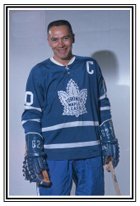
George Armstrong #10
The longest-serving captain in Toronto Maple Leafs history, George
Armstrong captained all four Maple Leafs Stanley Cup wins through
the 1960's, including the championship in 1967. Through twenty NHL
seasons, all played in Toronto, 'The Chief' collected 713 points in
1,188 regular season games, including 33 during the 1966-67 season.
Armstrong was elected to the Hockey Hall of Fame in 1975.
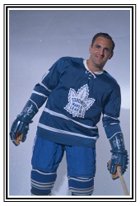
Bobby Baun #21
Through the early sixties, few teams could boast a blueline brigade
as formidable as Tim Horton with Allan Stanley and Carl Brewer with
Bobby Baun. Having risen through the junior ranks as a member of the
Toronto Marlboros, Bobby debuted with the Leafs in 1956-57 and for
11 seasons, provided bone-crunching bodychecks and great defense as
well as a little bit of offense at just the right time - like Game 6
of the 1964 Stanley Cup final when, shaking off a broken foot, scored
the deciding goal in overtime. Baun was picked up by Oakland in the
expansion draft that followed Toronto's '67 win, but returned to
Toronto for three more seasons beginning in 1970-71. Bobby Baun
proudly wears four Stanley Cup rings, all won with the Toronto Maple
Leafs.
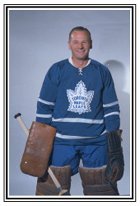
Johnny Bower #1
No one, least of all Johnny Bower himself, thought that he'd be a
member of four Stanley Cup-winning teams with the Toronto Maple
Leafs. After 13 outstanding seasons lingering in the AHL, with
only a brief NHL respite for a coffee as a New York Ranger, Bower
was claimed by Toronto in the inter-league draft, and his
acquisition helped turn around Toronto's woeful results of the
1950's. In 1967, the 42-year-old Bower, paired with Terry Sawchuk,
provided stellar netminding that allowed a team labeled as the
'Over the Hill Gang' to steal the Stanley Cup from the favoured
Montreal Canadiens. Bower played his final NHL game in 1970,
joining the Leafs as a scout and goaltending coach after his
retirement as a player.
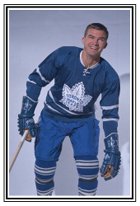
Brian Conacher #22
After scoring twice in Game 6 of the semi-final to help oust the
Hawks, Brian Conacher stepped into the Stanley Cup final and was
both an offensive force and a physical presence against the
Canadiens. It was a year of great satisfaction for Brian, who
continued the Stanley Cup tradition begun by his father, Lionel,
who won the Cup with Chicago in 1934 and the Maroons in 1935, and
uncles Charlie (a championship with Toronto in 1932) and Roy (was
part of Stanley Cup winners in Boston in 1939 and 1941). Brian
made his NHL debut with a game played for the Leafs in 1961-62 and
2 more in 1965-66, finding full-time NHL employment in 1966-67,
when he scored 14 goals and 27 points. Conacher's last NHL season
was 1971-72 with Detroit.
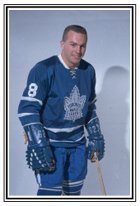
Ron Ellis #8
One of the most productive Leafs in their storied history, Ron Ellis
spent his entire 15-season NHL career in the blue and white of the
Maple Leafs, collecting 640 points in 1,034 regular season contests.
Runner-up to Roger Crozier as rookie of the year in 1965, Ellis's 22
goals led the team in 1966-67, and he scored the all-important opening
goal of the final series against the Canadiens. Ron retired during the
1980-81 season.

Aut Erickson #24
Aut Erickson had played two seasons each with Boston and Chicago
before joining the Toronto Maple Leafs organization as part of the
May 1965 deal that brought Marcel Pronovost and Larry Jeffrey to
Toronto . But his career with the Maple Leafs consisted of one game
- Game 1 of the 1967 Stanley Cup final, when he served a too many
men on the ice penalty in the first period and played one shift on
defense in the third period of a 6-2 Toronto loss. Erickson finished
his NHL career with the Oakland Seals. His regular season NHL totals
show 226 games played, 7 goals scored and 31 points collected.
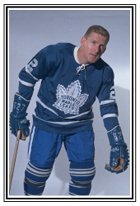
Larry Hillman #2
During an era when the Leafs boasted a blueline consisting of Bob
Baun and Hall of Famers Tim Horton and Allan Stanley, it was tough
to crack the lineup, but Larry Hillman showed great patience. After
winning the Stanley Cup as a rookie with Detroit in 1955, Hillman
toiled for Boston before Toronto claimed him in the 1960 Intra-
League Draft. Larry was a full-time Leaf in 1960-61, but was
shuffled between the NHL club and its AHL affiliate in Rochester
for the next seven years. During the 1966-67 season, Hillman played
55 games with Toronto, contributing 23 points and providing solid
defense, especially during the playoffs when Larry truly proved his
worth to the Maple Leafs. The much-travelled Hillman later played
with Minnesota, Montreal (where he enjoyed another Cup victory),
Philadelphia, L.A. and Buffalo, finishing his NHL career with 790
games played and 232 points.
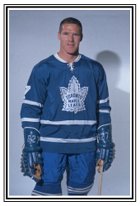
Tim Horton #7
Originally expected to replace Bill Barilko on the blueline after
the tragic disappearance of the Leafs' #5 in 1951, Tim Horton took
a little while to make his mark, not joining Toronto full-time until
1952-53. But by his second season in Toronto, Horton had already
earned the first of his six All-Star designations. Strong, dependable,
not afraid to rush and possessing a blistering shot, Tim was an
integral part of the Leafs' success through the 1960's. In 1966-67,
Horton scored 8 times, adding 17 assists as well, and was named to the
NHL's Second All-Star Team. During that spring's playoff, Tim added 3
goals and 5 assists in 12 games. After stints with the Rangers and
Penguins, Horton joined Buffalo in 1972. On the morning of February 21,
1974, Tim Horton was killed in a single-car accident, but his legacy
remains - a Hall of Fame career and a business that has now made his
name synonymous with coffee in Canada.
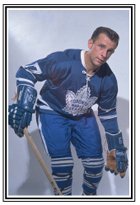
Larry Jeffrey #15
After four seasons with the Red Wings, Larry Jeffrey found himself
part of the trade that involved Marcel Pronovost to Toronto and Andy
Bathgate to Detroit. During the 1966-67 campaign, Jeffrey scored 11
goals and contributed 17 assists. But during the playoffs, Larry played
just 6 games before injuring his leg. But crutches didn't deter Jeffrey
- when the Stanley Cup was presented to his Maple Leafs, Larry was on
the ice in his suit, hobbling about on crutches.
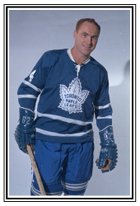
Red Kelly #4
Red Kelly has the unique perspective of having played with two
dynasties. Through the 1950's, a decade that saw Kelly named to
the All-Star Team a remarkable eight straight seasons, Red was the
premier defenseman on the Detroit Red Wings, helping that franchise
win four Stanley Cup championships. Traded to Toronto in February
1960, Kelly was converted to a centre and proceeded to earn four
more Stanley Cup rings. In 1966-67, his final NHL season, Kelly
scored 14 goals and added 24 assists, contributing to the 823 points
he'd earn in 1,316 regular season games over 20 NHL seasons. Red
Kelly was inducted into the Hockey Hall of Fame in 1969.
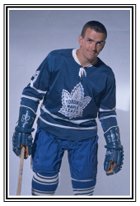
Dave Keon #14
Dave Keon made a sizeable impact with his NHL debut in 1960-61,
earning the Calder Trophy as the league's best rookie. As part of
the dynasty, the gentlemanly Keon contributed substantially to all
four Stanley Cup championships won by Toronto during the sixties.
In 1966-67, his 52 points led the Maple Leafs in scoring, but his
contributions defensively were equally important to the team. After
the victorious conclusion of the playoffs in 1967, David was named
the Conn Smythe Trophy winner as the most valuable playoff performer
that spring. Later named captain of the Leafs, Dave Keon had a
spectacular 16-season NHL career, finishing with 986 points in 1,286
regular season games, and in 1986, was elected to the Hockey Hall of
Fame.
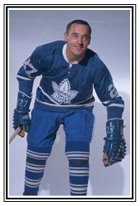
Frank Mahovlich #27
Few players have left as lasting an impression on Toronto fans as
'The Big M,' Frank Mahovlich. Much sought after as a youngster, the
Maple Leafs signed Mahovlich and assigned him to St. Mike's. Making
his debut in 1956-57, the big winger led a parade of exciting junior
talent that would form the nucleus of the dynastic team through the
sixties. Frank missed the first two games of 1966-67, his tenth NHL
season, in a contract dispute, then saw his production slip to 18
goals and 46 points, his lowest output in seven years. Frank was a
six-time All-Star during his tenure in Toronto, but later starred
with Detroit and Montreal, where he was part of two more Stanley Cup
championships to go along with the four he won with the Maple Leafs.
Mahovlich was elected to the Hockey Hall of Fame in 1981.
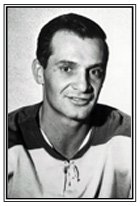
Milan Marcetta #25
A career minor leaguer, Milan Marcetta was in the right place at the
right time in 1967. After spending the regular season with Victoria
of the WHL, Marcetta was summoned to the parent Maple Leafs for the
playoffs as insurance, and was inserted into the line-up for 2 semi
-final games against Chicago as well as the second game of the
Stanley Cup final versus Montreal. During 1967-68, Milan played with
Rochester until a mid-season trade sent him to the North Stars. He
spent parts of two seasons with Minnesota before returning to the
minors.
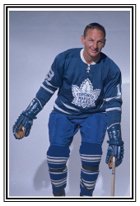
Jim Pappin #18
Jim Pappin enjoys the renown of having scored the Stanley Cup-winning
goal for the Maple Leafs in 1967. At 19:24 of the second period on May
2, Pappin attempted a backhand pass to Pete Stemkowski, but the puck
caromed off Montreal defenseman Terry Harper and into the Canadiens'
net. A 21-goal scorer with the Leafs in 1966-67, his fourth partial
season as a Leaf, Jimmy led the NHL in playoff scoring that spring,
collecting 15 points. After one more season with Toronto, Pappin was
dealt to Chicago, and later played with the Golden Seals and Cleveland
Barons.
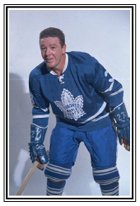
Marcel Pronovost #3
Marcel Pronovost arrived in Toronto from Detroit in a May 1965 deal
that also brought Larry Jeffrey and Aut Erickson to the Leafs. During
16 seasons with the Red Wings, Pronovost had won the Stanley Cup on
four occasions and was also a four-time All-Star in Detroit. Marcel
contributed defensive experience, as well as 14 points, to Toronto
during the 1966-67 season, winning his fifth Stanley Cup championship.
Pronovost's NHL career concluded during the 1969-70 season, and he was
elected to the Hockey Hall of Fame in 1978, having accumulated 345
points in 1,206 NHL regular season contests.
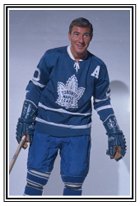
Bob Pulford #20
Another in the group of young turks that graduated from junior and
leapt to the Leafs, helping Toronto return to dynasty form, Bob
Pulford was an excellent two-way forward that, in 1991, earned entry
to the Hockey Hall of Fame for his fine 16-year NHL career that
included four Stanley Cup championships with Toronto. In 1966-67,
Pulford scored 17 goals and added 28 assists. Then, in the '67 playoffs,
he added a goal and 10 assists to aid the Maple Leafs' effort. His sole
goal that spring was of monumental importance - at 8:26 of the second
overtime period on April 25, Pulford beat Rogie Vachon of the Canadiens
to win Game 3 3-2, putting the Leafs up two games to one in the series
that they would eventually win.
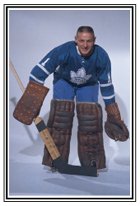
Terry Sawchuk #30
Terry Sawchuk had enjoyed a brilliant career even before joining the
Toronto Maple Leafs in 1964. Backstopping the Detroit Red Wings to
three Stanley Cup championships, Sawchuk had also been a seven-time
All-Star and a three-time Vezina winner in Detroit over 12 seasons,
and had played two seasons with Boston sandwiched between his Red
Wing successes. In 1964-65, the veteran shared netminding duties and
a Vezina Trophy in Toronto with Johnny Bower. In 1966-67, Terry won
15 games, including 2 of his career 104 shutouts, and posted a 2.81
goals against average in 28 appearances. In 10 playoff contests, the
38-year-old Sawchuk won 6 games to help the Maple Leafs win the
Stanley Cup. With NHL expansion the next year, Terry played in Los
Angeles, joining the Red Wings and Rangers for one season each
subsequent to that. On May 31, 1970, Terry Sawchuk died, and was
posthumously inducted into the Hockey Hall of Fame in 1971.
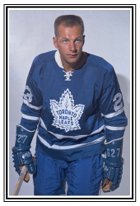
Eddie Shack #23
Eddie Shack joined the Maple Leafs in February 1960 after spending
several years with the New York Rangers organization. In his first
three full seasons, the crowd favourite known as 'The Entertainer'
helped the Leafs win Stanley Cup championships, stirring up the crowd,
scoring a timely goal, going toe-to-toe with an opponent or winding up
and flying down the ice in inimitable Shack style. In 1966-67, Eddie
scored 11 goals and a total of 25 points, disappointing after a 26-goal
season the year before. Eddie dressed for only two of the six games of
the Stanley Cup Final and almost immediately after the celebration, was
traded to Boston. He returned to Toronto in 1973-74 after stints with
the Bruins, Kings, Sabres and Penguins. Although Johnny Bower recorded
a hit single ('Honky the Christmas Goose'), only Eddie can brag of a
hit song being written about him - 'Clear the Track, Here Comes Shack'
by Douglas Rankine and the Secrets.
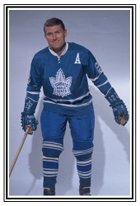
Allan Stanley #26
Allan Stanley arrived in Toronto in 1958 after serving time with the
Rangers, Black Hawks and Bruins. Already 32 and never known for his
speed, Allan found a new gear with the Leafs and earned All-Star
acclaim in 1960, 1961 and 1966. During the 1966-67 season, Stanley
earned just 13 points, but was a rock on defense, most often teamed
with Tim Horton on the blueline. Allan spent 10 years as a Maple Leaf,
finishing his career with Philadelphia. In 1981, the Selection
Committee of the Hockey Hall of Fame welcomed Stanley with hockey's
highest reward.
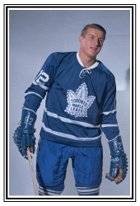
Peter Stemkowski #12
Pete Stemkowski enjoyed his best season as a Leaf in 1966-67, scoring
13 goals and adding 22 assists for 35 points. In the playoffs,
'Stemmer' contributed at a point a game pace, scoring 5 goals and 7
assists in 12 post-season contests. During the season following the
Cup win, Pete was dealt to Detroit as part of the Frank Mahovlich
trade. In 967 regular season games, played as a Leaf, Wing, Ranger
and King, Stemkowski tallied 555 points.
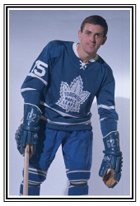
Mike Walton #16
Mike Walton began the 1966-67 season with the Rochester Americans,
but was called up mid-season and contributed 17 points in 31 regular
season games. Walton then proceeded to add 4 goals and 7 points
during the 1967 playoffs. Mike became a Leaf regular the next season,
scoring a career-best 30 goals in 1967-68. Through 12 NHL seasons,
spent with Toronto, Boston, Vancouver, St. Louis and Chicago, Walton
collected 448 points in 588 regular season contents. In three WHA
seasons, Mike played 211 games and recorded 281 points, including a
league-best 117 for Minnesota in 1973-74.
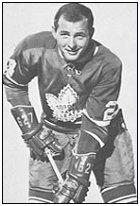
John Brenneman #24
John Brenneman's 162-game NHL career took him from Chicago to New York,
Toronto to Detroit and concluded in Oakland. John split the 1966-67
season between the Leafs and Rochester, their AHL franchise, collecting
6 goals and 4 assists for 10 points in the 41 games he played with the
parent club during the regular season.
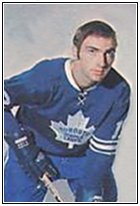
Wayne Carleton #25
The blueprint for Wayne Carleton was laid out long before he joined the
Maple Leafs, who salivated like Pavlov's dogs at the thought of adding
the big, strong winger to their lineup. During his fifth season of
junior, his young career already including a Memorial Cup championship,
Wayne was called up to play 2 games with the Leafs. In 1966-67, Wayne
played 5 more games and scored his first NHL goal, but spent the bulk of
the season split between Tulsa and Rochester. Carleton's career with
Toronto lasted only until December 1969 when he was traded to the Bruins,
and won a Stanley Cup championship with Boston that year.
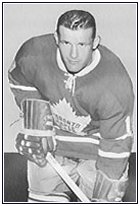
Kent Douglas #19
After spending three seasons with Springfield of the AHL, earning best
defenseman honours and a First Team All-Star berth in 1961-62, Kent
Douglas joined the Toronto Maple Leafs in 1962-63 and solidified the
defense, helping the team to the first of three straight Stanley Cup
championships and earning personal glory as the NHL's best rookie of
1962-63. In 1966-67, Kent split the season between Tulsa of the Central
Hockey League, Rochester of the American Hockey League and spent 39
games with the parent Maple Leafs, scoring twice and adding 14 points.
Kent did not play in the playoffs, and was selected by Oakland in the
1967 Expansion Draft. In 428 regular season NHL games, Kent Douglas
collected 148 points, playing with Toronto, Oakland and Detroit.
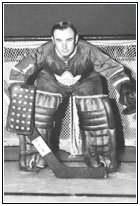
Bruce Gamble #1
After bouncing through the minors earlier in his career, including
stints with the Rangers and Bruins, Bruce Gamble joined the Maple Leafs
in 1965-66 and in 1966-67, split the netminding duties with Johnny Bower
and Terry Sawchuk. Gamble saw action in 23 contests, earning a 3.30
goals against average. During his sixth season as a Leaf, Gamble was
traded to Philadelphia in a deal that involved Bernie Parent. Bruce
suffered a career-ending heart attack during a game February 9, 1972
and died December 29, 1982.
No Photograph's
Brent Imlach #9
The 1965-66 season was a memorable year for Brent Imlach. In his first
full season of junior, Imlach collected 23 goals and 41 points in 45
games with the Toronto Marlboros, and was summoned to the Toronto Maple
Leafs for two games in January to replace the injured Wally Boyer. In
1966-67, while attending the University of Western Ontario, Brent played
with the junior London Nationals, also a Toronto property, accumulating
18 points in 46 contests. During that campaign, Imlach was called up to
the Leafs for a single game, reporting to coach Punch Imlach, his father.
Brent had an outstanding university career, and was sold by the Leafs to
Buffalo when Brent's father was GM of the Sabres, but never played
another NHL game.
Jim McKenny #25
The skilled defenseman laboured in the minors as he waited on breaking
into a Hall of Fame defense corps, but Jim McKenny played 6 games as a
member of the '67 Leafs, scoring 1 goal during the regular season. He
earned full-time status in 1969-70, and spent 9 seasons with the Leafs
before concluding his career with the Minnesota North Stars. In 604 NHL
games, McKenny contributed 329 points. Today, Jim is a sportscaster at
Toronto's CITY-TV.
Duane Rupp #3
The Maple Leafs had one of the finest defense corps in hockey history
during the 1960's, making it difficult through the years for defensemen
like Al Arbour, Kent Douglas, Larry Hillman, Marc Reaume and others to
find a regular spot on the team's blueline. Duane Rupp faced the same
challenge. After Toronto secured him from the Rangers' organization,
Duane played 2 games for the Leafs in 1964-65, 2 in 1965-66 and 3 in
1966-67, spending the majority of that season with the AHL's Rochester
Americans. Rupp became a full-timer with Toronto the next season.
Brit Selby #11
Brit Selby was a junior phenom with the Toronto Marlboros, scoring 24
goals in each of his first two full junior seasons and 45 in his last
junior campaign. That year (1964-65), the Leafs called the young winger
up for his NHL debut, and he dazzled, scoring 2 goals in his 3-game
tryout. The next season, Brit was named rookie of the year, collecting
27 points as a Maple Leaf. Injuries curtailed Selby's sophomore season,
and he played just 6 games with Toronto in 1966-67, scoring a goal and
an assist and not seeing any playoff action. Selby was dealt to
Philadelphia in 1967-68, but returned to Toronto in a trade for Bobby
Baun in November 1970, spending parts of three seasons back in blue and
white before a trade sent him packing for St. Louis. In 350 regular
season NHL games, Brit Selby claims 117 points.
Al Smith #30
With the Leaf netminders aging, Toronto looked to goalkeepers like Al
Smith as the future. After starring with the junior Marlboros, Smith
played two games in goal for Toronto in 1965-66, enjoying but one game
in 1966-67. Smith spent most of that season with the Western Hockey
League's Victoria Maple Leafs, joining that league's Vancouver Canucks
during the playoffs. The journeyman played with Pittsburgh, Detroit,
Buffalo, Hartford and Colorado during his stint in the NHL, also adding
5 seasons with New England of the WHA. Al died of cancer August 7.
Gary Smith #1
Gary Smith earned the nickname 'Suitcase' due to the number of teams he
played with through his hockey career. Earning junior time with St.
Michael's, Neil McNeil and the Marlboros, Smith was shuffled between
Leaf farm teams in Tulsa, Victoria and Rochester before he saw his first
NHL action in 1965-66. During the 1966-67 season, Gary played 2 games,
with the remainder of the season split between Rochester and Victoria.
The son of Des Smith, who won a Stanley Cup with Boston in 1941, in June
1967, Gary was selected by Oakland in the NHL Expansion Draft. He'd also
later wear the NHL sweaters of California, Chicago, Vancouver, Minnesota,
Washington and Winnipeg before retiring in 1980.
A restless Leaf Nation relives the glory of '67
For a night, Keon & Co. will dull the pain of a 40-year wait
Wayne Scanlan , The Ottawa Citizen
Published: Saturday, February 17, 2007
Today, it is a source of derision as much as pride. The Maple Leafs haven't won
a Stanley Cup since 1967?
If the prairies knew a drought like this, there would be no farms left in the country.
Fourteen different organizations have been crowned during those 40 dry years in Toronto,
including such alien hockey destinations as Carolina and Tampa Bay.
Carolina and Tampa? In 1967, when those good ol' crew-cut boys in blue raised the Cup for
the fourth time in the '60s, champions from the planet Mars would have seemed as likely as
Lord Stanley's bowl on Tobacco Road or the Tampa beaches.
Tonight, though, the Leafs jokes subside.
Tonight the pride wins out in a celebration of faded Leafs glory and lost innocence.
Tonight, across the nation, goosebumps will run down spines when Dave Keon, the mighty
little centre who played his heart out for the Leafs, and had his heart broken by the Leafs,
joins his 1967 teammates and steps onto the Air Canada Centre ice to mend a feud that has
simmered for three decades.
No one represented the Leafs better than Keon, at home, on the road or in the vivid
imagination of a child. Legendary Toronto hockey writer Frank Orr used to joke that in a
Leafs road game, the three star selections were set in advance -- Keon and the two opposing
goalies, in whatever order.
Hardly an imposing figure at 5-9 and 165 pounds from Noranda, Que., Keon could skate a river,
his head up, his posture perfect. Though never a prolific scorer, Keon was once considered by
many in Toronto to be the quintessential Maple Leaf; the one Leaf who played in a young fan's
dreams. Typical of his style, he scored just three goals and five assists in Toronto's 12
playoff games in 1967, and yet Keon deservedly won the Conn Smythe Trophy as playoff MVP for
his relentless checking and ultimate presence.
Months later, Keon had a contract disagreement with a shark named Harold Ballard, just beginning
to wrestle the club ownership from the Smythe family.
After he played out his career in the World Hockey Association and with the NHL Hartford Whalers,
Keon and the Leafs made some attempts at reconciliation, but he couldn't get over the hurt caused
when Toronto declined to follow the Montreal Canadiens' example of retiring the sweater numbers
of their stars.
Ace Bailey (6) and Bill Barilko (5) are the only Leafs with retired numbers.
In the Damien Cox and Gord Stellick book '67: The Maple Leafs, Their Sensational Victory and the
End of an Empire, Keon called the Leafs' system of "honouring" numbers "a chickenshit way to do
things."
Keon said he was embarrassed for legends like Syl Apps and Ted Kennedy who went before him, and
had to see their numbers remain in circulation.
"I'm embarrassed for them all," Keon said. "I confronted (then Leafs president) Ken Dryden and said,
'Do you think the Montreal Canadiens would just honour the Rocket's number?'"
Dryden's own No. 29 was recently retired by the Habs.
Keon's number has not yet been "honoured" by Toronto. Perhaps tonight's ceremony will be the first
step in having No. 14 properly retired.
Even though the Leafs roster was creaking with age, the demarcation point wasn't as obvious then as
it would soon become -- that the franchise would so rapidly decline and decay. This was, after all,
the Leafs' fourth Stanley Cup of the 1960s, including three straight from 1962-64.
The assumption was that there would be plenty more, if not immediately, then soon enough. In the
days of the NHL's Original Six teams, the Cup had generally alternated between Toronto and Montreal,
in a two-for-the Habs, one-for-the-Leafs kind of way, with an occasional detour to Detroit.
No one knew what to make of this new animal called expansion, a doubling of the league to 12 teams
from six, on the horizon for 1967-68.
If only Leaf Nation had envisioned how precious an event the 1967 Cup season was to become, it might
have celebrated more heartily.
"I think there was some sense in the city that this was just another Cup," says winger Ron Ellis, at
22 one of the few youngsters in the 1967 lineup.
"Leaf fans were a little spoiled at that time. It was their fourth Cup in six years, and so it didn't
spark quite the same celebration as the first Cup in the '60s.
"But we knew it was special because it was the end of an era," says Ellis.
"Whoever won that Cup was going to have a place in history as the last champion of the six-team league."
A director of public affairs at the Hockey Hall of Fame, Ellis points with pride to the fact that 10 of
those '67 Leafs have been enshrined in the Hall.
And yet, most were declared over the hill in the spring of '67.
"We weren't expected to win," Ellis says. "We had a lot of adversity during the season.
"It was a miracle win by a chiselled, veteran team with a few kids following along."
- - -
The hockey story alone makes the '67 Stanley Cup special. The story beyond the action makes it stand
alone as the last season of hockey innocence.
The average salary of the 1967 Leafs, with such names as Keon, Frank Mahovlich, Terry Sawchuk, Johnny
Bower, Allan Stanley and Tim Horton, was $20,000. Canadian currency. Mahovlich, the one true superstar
of the group, earned $32,000. The heroes of the day were paid ordinary sums and had lives much like the
fans who adored them.
Ten years after he joined the team, Leafs captain George Armstrong bought a $22,000 home in Leaside and
needed two mortgages to pay if off.
Today's NHL rooms are a United Nations of millionaires.
The '67 Leafs roster was 100- per-cent Canadian.
Change came hard.
Expansion upon expansion, a new WHA league and a feisty group called the NHL Players' Association would
turn Canada's game into a cold business, with a strike in the 1990s and a lockout a decade later.
All the while, the fairytale that was the Leafs' image under Conn Smythe was being exposed and eradicated
in the Ballard era. Within seven years of the 1967 Cup win, two of its biggest stars, goaltender Terry
Sawchuk and the powerful defenceman, Horton, would be dead, under terrible circumstances. Ballard went to
jail on fraud charges, and laughed about his fancy dinners while incarcerated.
Stories would also develop, though they took decades to be fully disclosed, about a sex abuse scandal inside
a Maple Leaf Gardens arena that was a hockey shrine to millions of fans in Canada, with Foster Hewitt giving
the weekly sermon.
In 1999, the Gardens was closed, and Keon declined to attend the ceremony to mark its passing.
- - -
Of Toronto's 13 Cup wins, second only to Montreal's 23, the 1967 championship was perhaps the least likely.
The '67 Leafs were an old team; the average age was 31, ancient in the years before modern nutrition and
training. Players routinely retired by the age of 35. Some of the '67 Leafs were just getting going by then.
Like so many other years in the 1960s and '70s, this should have been Chicago's time.
When fans talk of Toronto's miracle run of '67, it is usually with the archrival Canadiens in mind -- the team
Toronto vanquished in the final.
The bigger upset took place in the semifinals, against the loaded, first-place Chicago Black Hawks. Their slick
centre, Stan Mikita, was in his prime, having just won his third scoring title in four years. The year he didn't
win, in 1965-66, he came second to teammate Bobby Hull. Mikita had Kenny Wharram and Doug Mohns on his wings to
form the top scoring line in the game. Not far behind was the trio of Hull with Chico Maki and centre Phil
Esposito, before he popped off and went on to fame and fortune in Boston.
The Hawks, Cup winners in 1961 (and still awaiting an encore), scored the most goals in the NHL in 1966-67 and
yielded the fewest.
"They were looking to create their own dynasty," Ellis says.
By comparison, the third-place Leafs had mediocrity stamped all over them like baggage ink. They gave up more
goals than they scored during the regular season, with 204 for and 211 against. During one horrible stretch,
they lost 10 straight games. Five different goaltenders tended Toronto's net that season, before 42-year-old
Bower and the 37-year-old Sawchuk settled in, brilliantly, for the serious games.
Sawchuk carried the load while Bower suffered through a painful groin injury, playing in just four games.
Remarkable little twists of circumstance guided the Leafs to the their destiny.
The Black Hawks, easily the more skilled and fluid team, were sabotaged in their own rink by a figure skating
show that left puddles on the slushy Stadium ice -- like an extra player for Toronto.
Punch Imlach, the Leafs' fiery head coach, fell ill during the latter part of the season and his assistant,
King Clancy, lightheartedly carried the team to a 7-1-2 record in Punch's absence.
(Imlach returned to close out the season with a more modest 6-5 record over the final games).
One of Clancy's strokes of genius as interim coach was to assemble a line of Pete Stemkowski between Jim Pappin
and Bob Pulford. The trio contributed 13 goals and 38 combined points in the two playoff rounds, and the big
Stemkowski ran roughshod over defencemen.
Another set of underdogs, Larry Hillman and Marcel Pronovost, were pillars on Toronto's defence in the 12 games.
The Leafs shut down the high-powered Hawks to win in six, before doing the same to Jean Beliveau and the Canadiens.
Habs coach Toe Blake had predicted a seven-game series after Montreal lost on home ice in Game 5.
Not this time. On May 2, 1967, it was all over. In another classic finale by Sawchuk, the Leafs finished the Canadiens
3-1 as Armstrong scored into an empty net.
Leafs fans, dressed in shirts, ties and jackets, having paid $1.50 to $7 for Game 6 tickets, looked on as the Leafs'
bench emptied in joy. Stemkowski grabbed the famous fedora off the head of coach Imlach and threw it in the air.
Armstrong was handed the Cup, and nearly dropped it tripping over a TV cord. That he didn't, was the final Leafs
miracle of 1967.
Seven-day subscribers can read previous columns by Wayne Scanlan at www.ottawacitizen.com . We welcome your comments
on this column or any other sports topic. e-mail us at sportsletters@thecitizen.canwest.com . The Ottawa Citizen 2007
Information from the Toronto Maple Leafs
Alumni 40th Anniversary Stanley Cup Dinner
THE TEAM
The Toronto Maple Leafs weren't expected to win the Stanley Cup in 1967. Pundits considered the team too old and too
slow to compete deep into the post-season.
At the end of the regular season, only 5 points separated the second through
fourth place finishers: Montreal with 77 points, Toronto with 75 and New York
with 72. But the highly-touted Chicago Black Hawks ran away from the pack,
finishing first with 94 points. The Hawks placed four players in the top ten
scoring leaders, including Stan Mikita and Bobby Hull who were one and two.
Toronto's leading regular season scorer was Davey Keon, who with 52 points, fell
just outside the top ten.
In the Semi-Finals, Toronto met Chicago, and if you listened to the media, the
Leafs might as well have started polishing their golfclubs right then. But shock
of shocks, Toronto dumped the Hawks in six games. The series took its toll on
the Leafs though. Larry Jeffrey tore the cartilage in his right knee in Game 6
and was gone for the remainder of the playoffs. George Armstrong injured his
left knee in Game 2 but later returned and Tim Horton broke his nose in Game 4.
Shining stars for Toronto included Frank Mahovlich, who scored 3 goals and 5
assists, Dave Keon with 2 goals and 4 assists and the Pulford-Pappin-Stemkowski
line, which contributed 7 goals and 17 scoring points to eliminate the hopeful
Black Hawks.
Montreal swept New York in the semi-final to set up a dream Stanley Cup Final.
To celebrate Canada's 100 th birthday, the two Canadian franchises met for the
bragging rights to the Stanley Cup championship.
Game 1 saw a dominant Canadiens squad spank Toronto 6-2, with Jimmy Pappin in
on both Leaf markers. But Toronto rebounded with a 3-0 blanking of Montreal in
Game 2, with Johnny Bower earning the shutout and the Stemkowski-Pappin-Pulford
line contributing to all three goals. Bob Pulford scored the deciding tally at
8:26 of the second overtime to give the Leafs an exhausting 3-2 Game 3 win.
Again, the prolific trio of Pulford, Pappin and Stemkowski was in on each of
Toronto's three goals.
The Canadiens returned with a vengeance in Game 4, dumping the Leafs 6-2 with
Sawchuk in goal. Yet, in the next game, Terry was on fire, holding Montreal to
one goal in a 4-1 Toronto win that saw the Canadiens yank netminder Rogie Vachon
after two periods, inserting the veteran Gump Worsley in his place.
Then, on May 2, 1967, with 15,977 in attendance at Maple Leaf Gardens, the
Toronto Maple Leafs earned the Stanley Cup with a 3-1 victory. Ellis opened the
scoring at 6:25 of the second, with Pappin adding a second goal at 19:24 of that
same frame. Former Leaf Dickie Duff brought Montreal close with a goal at 5:28
of the third but Toronto did everything to deflect the advances of the Canadiens.
At 19:05 of the third stanza, coach Punch Imlach sent out Allan Stanley to take
the faceoff in his own end. Stanley did his job, tying up Beliveau, while Red
Kelly collected the puck, dished it off to Pulford who then fed the captain,
George Armstrong, skating down the right wing. With Beliveau and Backstrom
scurrying back to protect their zone, Armstrong slid the puck into an empty net
to give Toronto the insurance marker needed to hold the game, the series and
ultimately, the Stanley Cup.
It was the end of an era. By the next autumn, the NHL had expanded to 12 teams,
and the team that had won the Stanley Cup just months before, had taken on a
different complexion. The Oakland Seals looked as much like the Leafs as Toronto
did itself, with Bobby Baun, Kent Douglas, Aut Erickson, John Brenneman and Gary
Smith from the '67 championship squad joining other former Leafs Wally Boyer,
Larry Cahan, Terry Clancy, Gerry Ehman, Ted Hampson, Billy Harris and former
Marlboro Charlie Burns. Terry Sawchuk was drafted by Los Angeles, where he'd
play for former teammate Red Kelly, who retired to accept the Kings' coaching
position. Brit Selby was drafted by Philadelphia and Milan Marcetta by Minnesota.
Eddie Shack was dealt to Boston and Larry Jeffrey to the Rangers. And then, in
one of the great blockbuster trades, Frank Mahovlich, Peter Stemkowski, Garry
Unger and the rights to retired Carl Brewer were packaged to the Red Wings for
Norm Ullman, Paul Henderson, Floyd Smith and Doug Barrie on March 3, 1968. The
team that battled to win the 11 th Stanley Cup championship during the spring of
1967 was now but a distant memory.
Since May of 1967, fans of the Toronto Maple Leafs have longingly embraced the
team's last Stanley Cup championship. The participants have taken on almost
mythic proportions - and with good reason. Since then, no fewer than 10 members
of the 1967 Stanley Cup champions have been elected to the Hockey Hall of Fame.
You know the names: Bower, Sawchuk, Armstrong, Horton, Kelly, Keon, Mahovlich,
Pronovost, Pulford and Stanley. Add coach Punch Imlach, a member of the Hall of
Fame in the Builder Category. All legends. All integral components of a
legendary spring.
Quite a story. Quite a team.
THINGS THAT HAPPENED IN 1967
- Bobby Orr's rookie season
- Last year of the Original 6
- First year of HNIC in full colour
- Canada's centennial
- Indira Ghandi elected
- Microwave oven is introduced
- Green Bay Packers win Super Bowl I - the first Super Bowl!
- Summer of Love
- 300,000 flower children gather in Haight-Asbury
- Thurgood Marshall - First Black appointee to U.S. Supreme Court
- Elvis marries Priscilla in Vegas
- Jack Ruby dies of cancer
- U.S. population reaches 200 million
- Muhammad Ali refuses his draft order for Vietnam
- Rolling Stone magazine debuts
- Dr. Christiaan Barnard performs world's first successful human heart transplant
- Best Picture - In the Heat of the Night
- Best Actor - Rod Steiger (In the Heat of the Night)
- Best Actress - Katherine Hepburn (Guess Who's Coming to Dinner)
- Top Songs - Ruby Tuesday, Up, Up, and Away, Penny Lane
- Top Album - Sgt. Pepper's Lonely Hearts Club Band
- Emmy Awards - Mission Impossible, The Monkees
- Top Television Program - The Andy Griffith Show
- Indy 500 Winner - A.J. Foyt
- U.S. Open Winner - Jack Nicklaus
- Heavyweight Boxing Champion - Cassius Clay
- U.S. President - Lyndon B. Johnson
- Canadian Prime Minister - Lester Pearson
- Minimum wage - $1.40
- Average Income - $7,305
- New home cost - $14,425
- New car cost - $2,724
- Gallon of gas - $0.33
- Gold - per ounce - $35
- Silver - per ounce - $1.55
- Cost of a first-class stamp - $0.05
HNIC - HOCKEY NIGHT IN CANADA in case anyone is wondering :)
A look at the 1966-67 NHL Season by
Bruce Trickey